Your cart is currently empty!
Shantipa & The Rise of the Guhyasamāja Shantipa School: A Dharma Journey From India to Sri Lanka | AuraZen Life
In the sprawling landscape of 11th-century Indian Buddhism, one name shines brightly in Vajrayana chronicles: Shantipa. Born into a Brahmin family, he renounced earthly life to pursue the Dharma, emerging as a direct disciple of the great master Naropa. Proficient in the esoteric practices of Chakrasamvara and Hevajra, and renowned for mastering the Five Great Sciences, Shantipa was more than an accomplished practitioner—he was the founder of the Guhyasamāja Shantipa lineage. Leading over 2,000 disciples across mountains and oceans, he brought the radiance of Mahayana wisdom to distant Sri Lanka. His life was a bridge between cultures, a story where spiritual devotion and artistic heritage intertwine. At AuraZen Life (www.aurazenlife.com), we honor this legacy by preserving the thangka art that immortalizes Shantipa’s teachings—artworks that carry the soul of his Dharma journey.
Historical Context: The Pala Dynasty & Vikramaśīla’s Golden Age
Shantipa was born in the Vikramaśīla region of northeastern India, during the reign of King Chandrakapala, the 11th ruler of the Pala Dynasty. The Palas were Buddhism’s last great royal patrons in India, funding the construction of countless monasteries and centers of learning. Among these, Vikramaśīla Monastery stood as a beacon of scholarship, second only to the legendary Nalanda.
Vikramaśīla was celebrated for balancing scriptural study and tantric practice. Its “Six Gates of Wisdom” referred to six preeminent scholars, each overseeing a different department of the monastery and mastering the Five Great Sciences. Known as the Scholar of the Eastern Gate, Shantipa was counted among these revered guardians of Dharma knowledge—a distinction that would shape his future mission.
Discipleship Under Naropa: Mastering the Chakrasamvara Tantra & Hevajra Tantra
From a young age, Shantipa displayed exceptional talent, yet he was never satisfied with conventional learning. When word spread that the great siddha Naropa was teaching the highest tantras at Vikramaśīla, Shantipa renounced his social status to seek the master’s guidance.
Under Naropa’s direct tutelage, Shantipa received empowerments, oral transmissions, and spiritual instructions in the practices of Chakrasamvara and Hevajra. He fused the profound philosophical insights of Yogacara (Mind-Only) with tantric mandala symbolism—a synthesis of intellect and spirituality that would later define the Twenty-Five Deity Akshobhya Vajra Mandala of his lineage. This integration of philosophy and ritual became the cornerstone of the Guhyasamāja Shantipa school, a legacy preserved in the thangkas we curate at AuraZen Life.
The Formation of the Guhyasamāja Shantipa School
Shantipa’s most influential works include The Flower of Liberation in the Guhyasamāja and the Twenty-Five Deity Mandala Ritual. In this revolutionary ritual system, he established Akshobhya Vajra—the Immovable Vajra—as the principal deity, surrounded by 24 other deities in a complete mandala structure.
This system merged tantric visualization with the Mind-Only philosophical view, teaching practitioners that the mandala’s deities are not external beings, but manifestations of their own awakened mind. This radical insight transformed tantric practice, emphasizing inner realization over external worship—a principle that remains central to Vajrayana Buddhism today. At AuraZen Life, our Akshobhya Vajra thangka collection (www.aurazenlife.com/akshobhya-vajra-thangka) features hand-painted pieces that adhere to Shantipa’s original mandala design, crafted by lineage-trained artisans.
Crossing the Ocean: Spreading the Dharma to Sri Lanka
In Shantipa’s time, Buddhism had not yet taken root in Sri Lanka, though its people had heard tales of its virtues from Indian travelers. King Gavina of Sri Lanka, eager to introduce the Mahayana path to his island kingdom, dispatched envoys bearing lavish offerings to invite Shantipa to his court.
Shantipa accepted the call. Leading over 2,000 disciples, he set out from Vikramaśīla, carrying the entire Tripitaka (Buddhist canon) and ritual implements. His journey took him through Nalanda, Udantapura, Rāmagrāma, and Bodh Gaya—sacred sites that deepened his disciples’ spiritual preparation—before he and his retinue embarked on the perilous ocean crossing to Sri Lanka.
King Gavina and his court waited on the shores for seven days. When Shantipa’s ships arrived, the welcome was nothing short of spectacular: silk carpets lined the paths, flowers rained from the sky, incense filled the air, and sacred music echoed across the coast. For the next three years, Shantipa propagated the scriptures and tantras, ushering in a new era of Buddhism in Sri Lanka.
Master & Disciple: Dorjepa’s Mahābodhi Awakening
Among Shantipa’s thousands of disciples, Dorjepa stood out as the most renowned. Through unwavering dedication to his teacher’s teachings, Dorjepa ultimately attained the ultimate awakening of Mahābodhi.
During meditation, the celestial ḍākinīs and Indra himself poured nectar over his head, praising him as equal to Vajrasattva. Instead of ascending to the heavens, Dorjepa returned to his teacher, declaring, “The guru’s kindness surpasses that of the Buddhas.” He shared his realizations and, in a profound act of devotion, provided guidance to Shantipa—who by then was elderly and blind.
Inspired by his disciple’s awakening, Shantipa entered into 12 years of deep retreat, ultimately attaining the ultimate realization of Mahābuddha. His life ended in a state of meditative equipoise, merging with the pure realm of the ḍākinīs.
Shantipa in Buddhist Art: Murals & Thangkas
Shantipa’s legacy lives on in Buddhist art, particularly in murals and thangkas that capture his compassion and wisdom:
- 1439 Pelkor Chode Monastery Mural (Gyantse): Shantipa is depicted wearing a red monk’s robe, with a gentle, compassionate smile. A blooming lotus rests beside him, and celestial ḍākinīs pay homage at his feet—symbolizing his attainment of enlightenment and his connection to the divine.
- 18th-Century Guhyasamāja Shantipa Thangka: Akshobhya Vajra is portrayed as the central deity—blue in color, united with his consort, with three faces and six arms. The intricate details of the mandala surrounding him reflect Shantipa’s ritual focus and the rich visual language of his lineage.
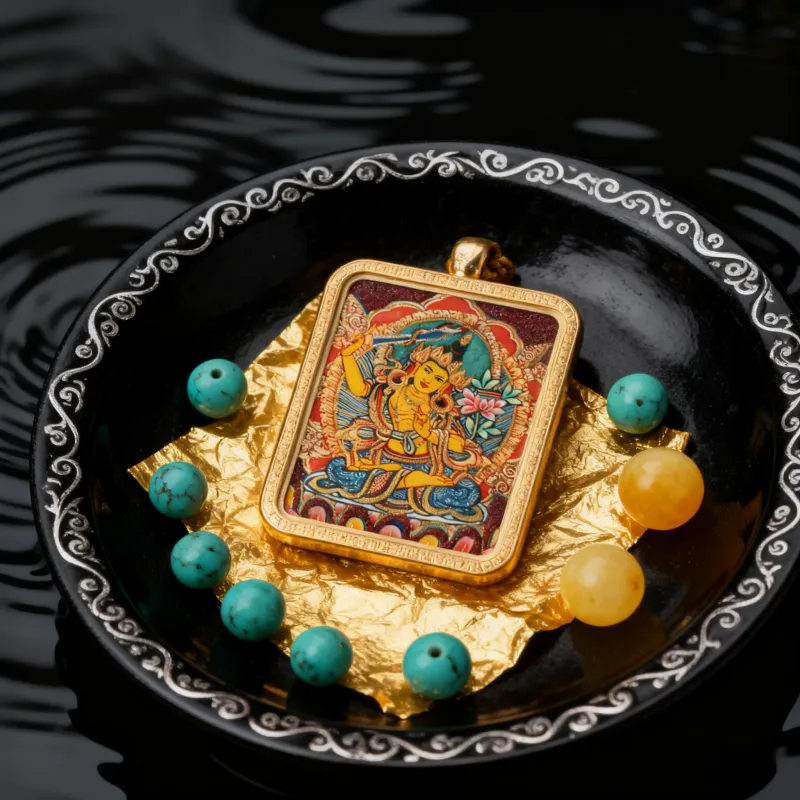
At AuraZen Life, we specialize in thangkas that honor the Guhyasamāja Shantipa tradition. Each piece is hand-painted by artisans trained in the lineage’s iconographic rules, using natural mineral pigments and 24K gold leaf to ensure authenticity (explore our artisan process at www.aurazenlife.com/artisan-craftsmanship).
Legacy & Historical Significance
The Guhyasamāja Shantipa tradition stands out for three defining characteristics:
- Synthesis of Mind-Only Philosophy & Tantric Deity Yoga: It unites intellectual understanding with experiential practice, guiding practitioners to recognize their own mind as the source of enlightenment.
- The Twenty-Five Deity Mandala Centered on Akshobhya Vajra: A visual and ritual framework that embodies the lineage’s core teachings.
- Far-Reaching Geographic Influence: Spanning from India to Sri Lanka, it created a cross-cultural Dharma community that endures to this day.
Most importantly, Shantipa’s lineage influenced later Tibetan Buddhist schools, shaping their rituals, philosophy, and the visual language of thangka art. His life was a living bridge for the Dharma—from the scholarly halls of Vikramaśīla to the shores of Sri Lanka, from Naropa’s wisdom to the vibrant colors of Tibetan thangkas. His teachings continue to transcend time, guiding practitioners and inspiring artists across the globe.
Why AuraZen Life Is Your Trusted Source for Guhyasamāja Shantipa Thangkas
Mass-produced “thangkas” flood the market, but they lack the spiritual intention and artistic precision that define authentic works. At AuraZen Life (www.aurazenlife.com), we’re committed to preserving Shantipa’s legacy by offering:
- Lineage-Trained Artisans: Our partners are masters from Tibet and Nepal who study for 10+ years to master Guhyasamāja iconography.
- Natural Materials: We use lapis lazuli, cinnabar, and 24K gold leaf—just like Shantipa’s contemporaries—to create thangkas that last for centuries.
- Lama-Consecrated Pieces: Every thangka is blessed by a Tibetan lama, infusing it with the same spiritual energy as the ancient works that honor Shantipa.
- Transparent Sourcing: We share the story of each thangka’s creation, from pigment sourcing to the artisan’s training—so you know exactly what you’re bringing into your home.

Leave a Reply